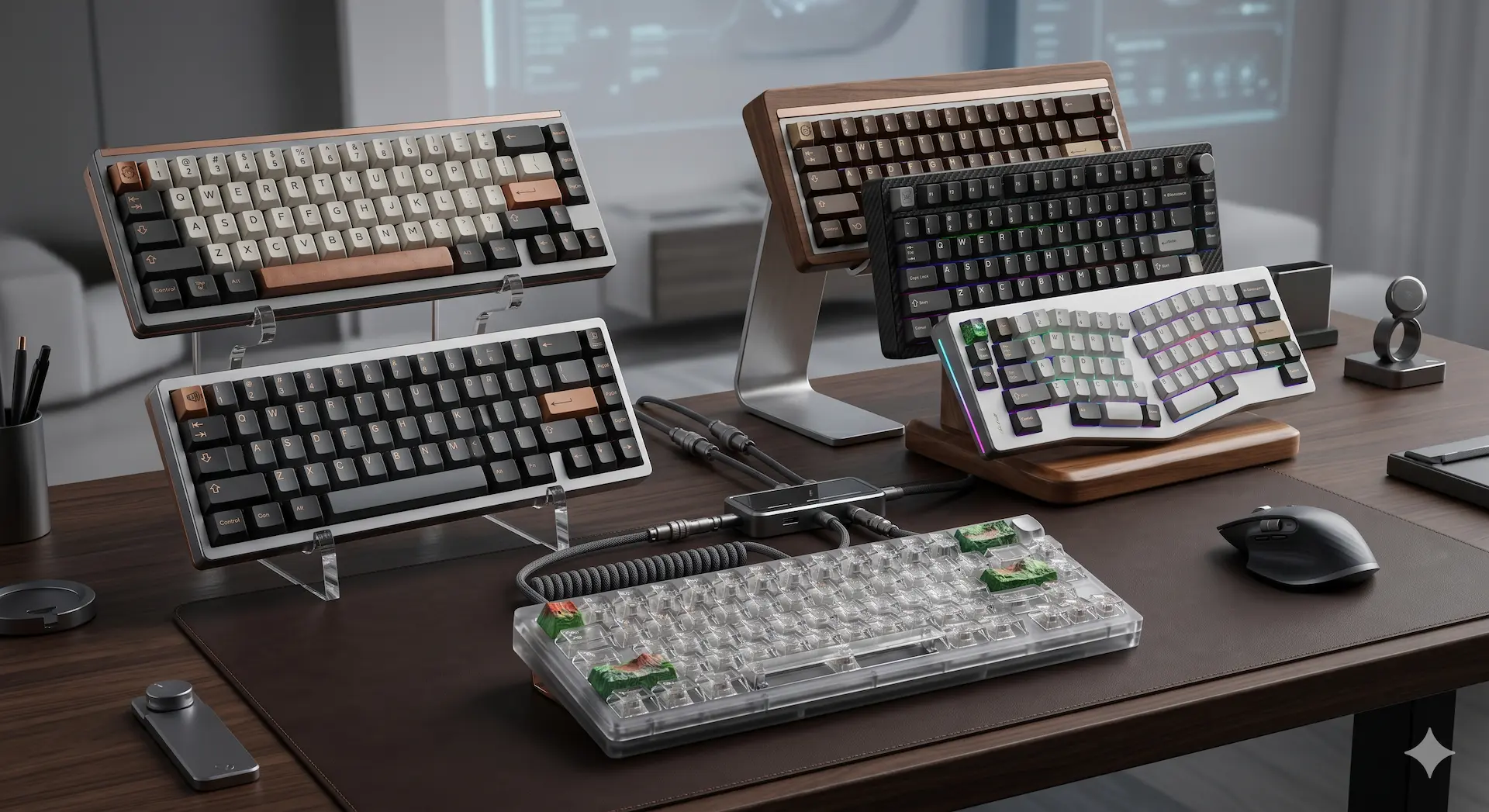
Best Premium Mechanical Keyboards 2026: Top 10 Picks for Superior Tactile Feedback
The mechanical keyboard market in 2026 is an absolute, maddening paradox. Globally valued at a staggering $2.79 billion, and it’s just a beginning. The industry has been completely overrun by mainstream adoption driven by Hall Effect (HE) magnetic switches, ultra-high 8K polling rates, and the baffling integration of TFT LCD screens directly into keyboard chassis. Everywhere you look, brands are chasing the rapid-trigger gaming demographic, pushing frictionless linear switches that actuate if you so much as breathe on them. Yet, amidst this relentless push toward hyper-sensitive gaming tech, a deeply stubborn, highly vocal subset of enthusiasts continues to chase a completely different, almost archaic holy grail: pure, unadulterated tactile feedback.
It is deeply frustrating to watch manufacturers prioritize a low-resolution OLED screen over proper stabilizer tuning or decent acoustic dampening. However, if you look beneath the noise of the mainstream gaming market, a quiet renaissance in tactile switch design and mounting architecture has actually occurred.
The era of the bone-rattling 67g hyper-tactile switch—the kind that felt like snapping a twig with every keystroke—has given way to a much more refined, early-actuating tactile experience. Travel distances have aggressively shortened. Mounting systems have evolved far beyond the lazy, uninspired implementation of PORON gasket strips slapped onto aluminum cases. The keyboards featured in this exhaustive report represent the bleeding edge of tactile typing in 2026. These are the top ten premium mechanical keyboards that deliver a superior tactile experience, analyzed strictly on their engineering, acoustic properties, and raw typing feel.
The 2026 Tactile Switch Meta: Moving Beyond the Boba U4T
Before we even begin to dissect the boards themselves, it is utterly impossible to evaluate a tactile typing experience without understanding the specific switches driving the market in 2026. The switch dictates the force curve, the acoustic resonance, and the fundamental resistance of the keystroke. The top-selling switches of early 2026 demonstrate a massive, undeniable shift in community preference. The heavy, exhaustive tactility of older switches like the legendary Boba U4T has been largely replaced by snappy, short-travel designs featuring long-pole POM stems and heavily modified nylon housings.
The Rise of the Early-Bump Tactile
Right now, the Sillyworks × Gateron Type R is one of the most popular choices for custom keyboard enthusiasts—and it’s easy to see why.
It has a medium actuation force of 55 gf and bottoms out at 60 gf, with a shorter-than-usual total travel distance of just 3.0 mm. What really sets it apart is how the tactile bump starts right at the top of the keypress. This means there’s no initial “dead” linear movement before you feel feedback, making each press feel immediate and responsive.
One downside is that the housing doesn’t allow light to pass through, so it’s not a good fit if you care about RGB lighting. However, this closed design contributes to a very crisp, clacky sound profile that transparent switches usually can’t match.
After the tactile bump, the resistance drops off quickly, allowing the key to travel smoothly. This makes typing feel easier on your fingers, especially during long sessions.
gf (gram-force): a unit that measures how much force is needed to press a key. Higher gf = heavier/harder to press.
mm (millimeters): a unit of distance; here, it describes how far the key travels when you press it.
High-Pitched Resonance vs. Muted Thock
For those chasing a brighter, more resonant sound profile, the HMX Black Cat has emerged as a top contender, often completely selling out upon restock. Utilizing a modified PA12 top housing and a P3 (Nylon + 30% Fiberglass) bottom housing, the Black Cat delivers a high-pitched, clacky, and fiercely bright signature. The tactile bump is shaped like a “D”—rounded and highly pronounced, culminating in a sharp bottom-out due to the hardened POM stem. It operates on a 22mm single-stage KOS spring, providing an aggressive, snappy return that feels incredibly alive under the fingers.
Conversely, the Mode Tomorrow switch offers a much wider, more robust tactile bump for those who hate the sharp “snapping” sensation. While the Gateron Baby Kangaroo V2 continues to be popular for its unique marble-like acoustics and two-stage gold-plated spring , the Mode Tomorrow utilizes a nylon housing and POM long pole to create a raw, muted sound that is highly subtle and incredibly sophisticated. Testing indicates that the stem wobble on the Tomorrow switches is practically non-existent, completely outclassing older tactile legends like the Outemu Bananas or Signals. If you want a switch that sounds like a deep, refined instrument rather than a plastic toy, this is it.
The Silent Tactile Revolution
For professional office environments, silent tactiles have historically been a miserable compromise, plagued by a mushy, unsatisfying bottom-out caused by internal silicone dampeners that feel like typing on wet cardboard. In 2026, this issue has finally been rectified. The Mode Anthracite (manufactured in collaboration with Outemu) delivers a smooth, quiet bump without the frustrating stickiness at the top of the keystroke that plagued earlier generation ZealPC Zilent switches. It offers a slightly lighter bump but makes zero compromises on smoothness. Similarly, the TTC Bluish White V2 Silent remains a massive top seller, offering a distinct tactile bump right at the top of the press while remaining quiet enough for an open-plan office.
| Switch Name | Actuation | Bottom-Out | Travel Distance | Acoustic Profile | Bump Characteristics |
| Sillyworks x Gateron Type R | $55 \text{ g}$ | $60 \text{ g}$ | $3.0 \text{ mm}$ | Crisp, loud clack | Top-heavy, sharp |
| HMX Black Cat | $35 \pm 5 \text{ g}$ | $48 \pm 5 \text{ g}$ | $3.0 \pm 0.3 \text{ mm}$ | High-pitch Poppy | D-shaped, rounded |
| Mode Tomorrow | $61 \text{ g}$ | $65 \text{ g}$ | $3.3 \text{ mm}$ | Muted, raw | Wide, pronounced |
| Gateron Baby Kangaroo V2 | $59 \text{ g}$ | $67 \text{ g}$ | $3.4 \text{ mm}$ | Marbly, mid-pitch | Crisp, snappy |
| Mode Anthracite (Silent) | N/A | N/A | Standard | Silent, dampened | Light, smooth, no stick |
| TTC Bluish White V2 | N/A | N/A | Standard | Muted | Top-bump, distinct |
1. Keycult No. 3 TKL: The Unattainable Grail
The Keycult No. 3 TKL is an object of absolute, unyielding obsession within the mechanical keyboard community. Arriving in Q2 2026 after what felt like an absolute eternity of delays, vaporware accusations, and radio silence, it maintains Keycult’s terrifyingly perfect legacy of flawless CNC machining and extreme exclusivity. The board is offered through an à la carte configurator, allowing users to select case colors (White, Purple, Black, Navy, Silver, Yellow) alongside premium accent weights in Red, Copper, Silver, Black, and Brass.
Acoustic Profile and Engineering
Keycult single-handedly popularized the isolated gasket mount years ago, and the No. 3 perfects this architecture to a microscopic degree. When paired with an aluminum full plate and long-pole tactile switches, the acoustic signature is famously light and poppy—often referred to by veterans as the specific “Lego building” sound that broke the internet when Tfue used a Keycult 1/60 back in 2020. The sheer precision of the internal routing means there is absolutely zero hollow resonance within the chassis. Every single frequency is tightly directed upward through the keycaps, resulting in a sound profile that is impossibly clean.
The Brutal Reality of Aftermarket Pricing
Let’s have a moment of brutal honesty here. Paying massive aftermarket markups—often surging between $1,200 and $2,000—for a Keycult in 2026 borders on the absurd. The hobby has progressed so rapidly that $150 budget boards now feature gasket mounts, CNC aluminum cases, and complex acoustic foams that can achieve 85% to 90% of this exact sound profile. To pretend that a Keycult sounds ten times better than a Neo or a QwertyKeys board is pure delusion. However, for the uncompromising purist who demands absolute perfection in anodization, seamless 3D-contoured profiles, and zero visible external screws, the No. 3 TKL remains the undeniable, irrational king of the premium tactile experience. It is a functional piece of jewelry.
2. Wuque Studio Freya Ultra: The Kitchen Sink of Keyboards
Wuque Studio has built a massive reputation for pushing boundaries with their Mammoth and Promise lines, but the Freya Ultra is genuinely, wonderfully overwhelming. Weighing a staggering 3.5 kilograms, this 65% keyboard takes up the literal desk footprint of a TKL due to its highly controversial modular left-side macro cluster and slider. As if that wasn’t enough, it also features a prominent touchscreen knob in the upper right corner.
Tactile Feedback & Switch Synergy
The most fascinating and technically impressive aspect of the Freya Ultra is its internal mounting architecture. It utilizes a completely non-load-bearing gasket and spring structure, but the real star of the show is the first-of-its-kind split plate design. The outer perimeter of the plate is machined aluminum, providing rigid stability, while the inner alpha-cluster section is made of flexible polycarbonate (PC). This hybrid approach is an absolute revelation for tactile switches. The stiff outer edge ensures the stabilizers on the spacebar, enter, and backspace keys do not feel mushy or wobbly, while the PC inner plate absorbs the harsh kinetic bottom-out of long-pole switches like the HMX Black Cat. The result is a perfectly cushioned typing feel on the letters, with rock-solid feedback on the modifiers.
The Inevitable Flaws
To be brutally honest, the volume slider on the left module is incredibly gimmicky, highly prone to input lag, and often produces an irritating scratching noise when operated. Furthermore, early assembly reports indicate that the ribbon cable connecting the PCB is terrifyingly fragile and easily damaged during the build process. There are also rampant complaints in the community Discord regarding screws that strip instantly and cannot be unscrewed. Releasing a $450 to $600 kit with soft screws is entirely unacceptable. Yet, despite these glaring, infuriating flaws, the sheer acoustic brilliance of the split plate and the non-load-bearing spring mount makes the Freya Ultra one of the most uniquely satisfying tactile boards of the year. It is a wildly ambitious, slightly flawed masterpiece that sounds too good to ignore.
3. Mode Encore: The Crown Mounting Masterclass
If the Freya Ultra is a chaotic, maximalist experiment, the Mode Encore is the exact opposite: the absolute epitome of refined, purposeful, and mature engineering. Debuting as a premium 65% board with thick, chamfered bezels, the Encore replaces the beloved Envoy in Mode’s lineup. It features a stunning juxtaposition of materials, available in elegant, understated colorways like Monterey Dune, Black Sesame, and Matcha Cream.
The Crown Mounting System
The Encore introduces Mode’s brand new “Crown Mounting System,” and it completely changes the paradigm for tactile typing. Traditional soft mounts (like thick silicone gaskets) often render tactile switches feeling muddy or uneven, stripping away the crispness of the bump by absorbing too much energy. Conversely, rigid top mounts provide excellent, direct feedback but can sound incredibly metallic and cause severe finger fatigue over long typing sessions.
The Crown Mounting System connects the plate and PCB assembly to the chassis using a wave spring, a silicone spool, and a bushing, all meticulously stacked on a custom shoulder bolt at eight distinct mounting points. The result is phenomenal. The wave spring provides a highly springy, responsive return on the upstroke, literally pushing back against the fingers, while the tuned isolation stack completely eliminates unwanted metallic chassis resonance.
Typing Experience
When built with Mode’s own Tomorrow tactile switches on an FR4 or Carbon Fiber plate, the Encore delivers what is undoubtedly the most stable, clean, and satisfying tactile response on the market. At a 5.5-degree typing angle and a relatively low 12.5mm front height, it is incredibly comfortable without a wrist rest. It is a pure typing instrument that perfectly balances the comfort of a gasket mount with the rigid, satisfying feedback of a top mount. It feels like typing on a finely tuned suspension system.
4. Meletrix Zoom65 V3: The Modular Sandbox
Meletrix has entirely disrupted the entry-to-premium custom market with the Zoom65 V3. While their larger Zoom75 offers a standard, reliable gasket mount for the masses, the Zoom65 V3 throws the absolute kitchen sink at the builder, providing an unprecedented seven different mounting systems included in a single kit.
The Seven Mounts
For tactile switch users, the mounting plate and mechanism drastically alter the perception of the tactile bump. The Zoom65 V3 allows users to endlessly experiment with a traditional Top Mount, Silica Gel Particle Mount, Floating Pogo Mount, Split O-Ring Mount, Short-Arm Spring Mount, Non-Load Bearing Spring Mount, and the highly publicized Magnetic Levitation (Maglev) mount.
The Maglev mount suspends the entire PCB assembly using opposing magnets, creating a typing experience that is incredibly soft, bouncy, and acoustically isolated. However, the magnets are notoriously fragile and have been known to literally disintegrate or shatter if they accidentally snap together during installation. Honestly, this didn’t work for me at all; the assembly process for the Maglev is deeply finicky, requiring tiny plastic washers that are easily lost, and the ribbon cable placement is a masterclass in frustration, frequently getting caught during disassembly.
Finding the Sweet Spot
Despite the magnetic nightmare, the other mounts are spectacular. The Split O-Ring and Short-Arm Spring mounting options provide a subtle, highly pleasant bounce that slightly dampens the sound without detracting from the sharpness of a heavy tactile switch. For the tinkerer who wants to surgically tune their typing feel, this board is completely unparalleled. The ability to swap from a stiff top mount for sharp tactility to a bouncy O-ring mount for comfortable, long-form typing makes this an incredible value, even if the initial build process induces rage.
| Keyboard | Layout | Standout Engineering Feature | Tactile Synergy | Assembly Difficulty |
| Keycult No. 3 | 80% (TKL) | Isolated Gasket, Flawless CNC | Crisp, rigid feedback | Low |
| Wuque Freya Ultra | 65% + Macro | Split Alu/PC Plate | Cushioned alphas, rigid mods | High |
| Mode Encore | 65% | Crown Mount (Wave Spring) | Zero resonance, high bounce | Medium |
| Zoom65 V3 | 65% | 7 Mounting Styles (Maglev) | Ultimate modularity | Very High |
5. Realforce R4: The Stubborn Topre Evolution
No serious discussion of premium tactile keyboards can exist without addressing Topre. The electrostatic capacitive rubber dome switches offer a unique, rounded, deeply thocky tactility that MX-style mechanical switches simply cannot replicate, no matter how hard they try. The Realforce R4, released in late 2025/early 2026, attempts to bring modern features to the ancient Topre architecture, including capacitive touch, a highly sensitive proximity sensor for wake-on-approach, and Bluetooth connectivity powered by AA batteries.
The Good, The Bad, and The Rattling
The 45g silenced domes feel and sound fantastic, providing an unparalleled, rain-drop-like typing rhythm. The adjustable per-key actuation profiles are a brilliant use of the capacitive technology. However, the R4 has been plagued by severe, justified enthusiast criticism.
The chassis is incredibly difficult to open without causing permanent damage to the plastic clips, making aftermarket tuning and lubrication an absolute nightmare. Furthermore, teardowns have revealed that the dome strips inside the R4 are visibly pitted on the bottom, suggesting that Realforce’s manufacturing molds are heavily worn out and desperately need replacing.
The most egregious offense, however, is the stabilizers. The ticking and rattling on the stabilized keys—specifically everything except the spacebar—is an absolute disgrace for a keyboard that commands an $180+ to $250+ price premium. Enthusiasts like XMIT have previously designed custom laser-cut shims just to fix the rattling on Realforce RGB boards, and the fact that similar tolerance issues exist in the 2026 R4 is baffling. The keycaps remain thinner than premium GMK sets, and the lack of a native Linux software application is a massive oversight for the developer demographic. The R4 delivers the legendary Topre tactility, but the surrounding hardware execution feels incredibly lazy and unpolished compared to the aggressive innovation seen in the custom MX space.
The Good, The Bad, and The Rattling
The 45g silenced domes feel and sound fantastic, creating a smooth, rain-drop-like typing rhythm. The adjustable per-key actuation is a clever use of capacitive technology. However, the R4 has received significant criticism from enthusiasts.
The chassis is very difficult to open without damaging the plastic clips, making modifications and lubrication frustrating. Teardowns also show that the dome strips are visibly worn, suggesting aging manufacturing molds that need replacement.
The biggest issue is the stabilizers. Keys other than the spacebar suffer from noticeable ticking and rattling—unacceptable for a keyboard priced between $180 and $250. Enthusiasts have even created custom fixes in the past, and it’s surprising that similar problems still exist in the 2026 R4.
On top of that, the keycaps are thinner than premium alternatives like GMK, and there’s no native Linux software support, which is a major drawback for developers. While the R4 delivers the signature Topre typing feel, the overall hardware quality feels unrefined compared to modern custom mechanical keyboards.
6. HHKB Studio: The MX Betrayal
The HHKB (Happy Hacking Keyboard) Professional series has long been the absolute gold standard for compact Topre typing. Therefore, the release of the HHKB Studio—which abandons Topre entirely in favor of hot-swappable MX switches—was met with intense polarization and outright anger from purists.
Innovation vs. Restriction
The Studio is packed with incredibly unique productivity features. It includes a central trackpoint (reminiscent of classic Lenovo ThinkPads), integrated physical mouse buttons below the spacebar, and capacitive gesture pads on the sides of the case for scrolling and window management. Out of the box, it comes equipped with custom linear switches, but for tactile users, swapping in Durock T1 Silent Tactiles completely transforms the board. The incredibly thick plastic chassis, combined with a top-mounted steel plate, brings out a deeply satisfying, muted thock from silent switches that is highly appropriate for a quiet workplace.
However, the board is severely compromised by baffling, proprietary design choices. It utilizes specialized, non-standard keycaps for the keys surrounding the trackpoint (G, H, B) and a uniquely sized spacebar, effectively destroying the primary benefit of MX compatibility: aftermarket keycap customization. You are essentially stuck with the stock keycaps. Additionally, it completely lacks QMK/VIA support, forcing users to rely on inferior, clunky proprietary mapping software that has fewer features than the open-source alternatives.
The Verdict
For the traveling programmer or professional who requires a built-in mouse and refuses to take their hands off the home row, the HHKB Studio is an excellent, highly functional tool. But for the pure tactile enthusiast who values customization, it is a deeply confused product. If one desires the true, authentic HHKB experience, the HHKB Professional Hybrid Type-S, with its buttery-smooth Topre domes and superior acoustic consistency, remains the vastly superior option in 2026.
7. Mode Prologue: The Professional’s Savior
For years, the custom keyboard market has blatantly ignored anyone who requires a numeric keypad, relentlessly pushing 60%, 65%, and 75% layouts. If you worked in finance, data analysis, or simply preferred having a numpad, you were entirely out of luck in the premium space. The Mode Prologue finally answers the desperate pleas of these professionals by delivering an ultra-premium 98% (1800-compact) layout.
Layout and Functionality
The 1800 layout compresses the navigation cluster while fully retaining the numpad and function row, offering maximum utility in a slightly reduced desk footprint. The Prologue carries over the exceptional design language, thick bezels, and immaculate material finishes seen in the Sonnet and Encore models.
The Verdict
When outfitted with heavy tactile switches like the Sillyworks Type R, the Prologue transforms mundane data entry into a deeply satisfying, resonant acoustic exercise. While it lacks the extreme, chaotic modularity of the Meletrix Zoom series, it offers a level of build quality, dense acoustic dampening, and mature, office-appropriate aesthetics that are practically nonexistent in the full-size keyboard market. It completely redefines what a workstation keyboard can be.
8. Lofree Flow 2: Low-Profile Excellence with a Catch
The low-profile mechanical keyboard space is notoriously difficult to engineer. Shortened travel distances almost always result in harsh, jarring bottom-outs and anemic, scratchy tactility. The Lofree Flow 2, featuring a stunning CNC-machined one-piece aluminum body, 3.2x larger backlight cutouts, and an incredibly sleek design, is easily the most beautiful low-profile keyboard of 2026.
Software and Acoustics
Lofree finally answered widespread community demands by abandoning their proprietary software and including full QMK/VIA support out of the box, allowing for deep key remapping and macro programming. The typing feel is gorgeous, greatly enhanced by the five layers of internal dampening inside the redesigned gasket mount. When paired with Kailh Deep Sea Whale tactile switches, the feedback is surprisingly robust and satisfying for a low-profile board.
The Acoustic Tragedy
Unfortunately, the acoustic execution of the chassis is catastrophically flawed. Stock units suffer from a terrible ricochet noise—a high-frequency, metallic pinging caused by the interaction between the switch springs and the dense, unyielding aluminum case. Furthermore, the placement of the touch slider on the side of the board leads to constant, infuriating accidental actuations when simply moving or adjusting the keyboard on your desk. There is no way to permanently disable the power-saving mode in wireless operation either, which is a massive oversight. It is a brilliant, beautiful typing instrument that demands immediate aftermarket modification (like internal tape mods or heavier lubing) to be sonically acceptable.
9. Razer BlackWidow V4 Pro 75%: The Mainstream Infiltrator
It is incredibly rare for a mainstream, big-box gaming peripheral to earn a legitimate place among enthusiast-grade custom boards, but the Razer BlackWidow V4 Pro 75% has successfully bridged the gap.
Features and Tactility
This hot-swappable board comes equipped with Razer’s proprietary Orange tactile switches. Surprisingly, they are not terrible; they provide a highly respectable, moderate tactile bump that performs flawlessly in both rapid-fire gaming and heavy typing scenarios. The inclusion of a 4K Hz wireless polling rate, true per-key RGB that is blindingly bright, and high-quality textured PBT keycaps makes the hardware package undeniably robust.
The Software Nightmare
The hardware is exceptional, but the software is a deeply offensive experience. Synapse 3 continues to be a bloated, resource-heavy application that pushes advertisements and requires mandatory user registration simply to adjust basic keyboard functionalities. Frankly, it is an insult to the buyer to lock such brilliant hardware behind such invasive, poorly optimized software. If you can tolerate or bypass Synapse, the V4 Pro 75% is one of the most responsive, well-built tactile gaming boards ever produced by a mainstream brand.
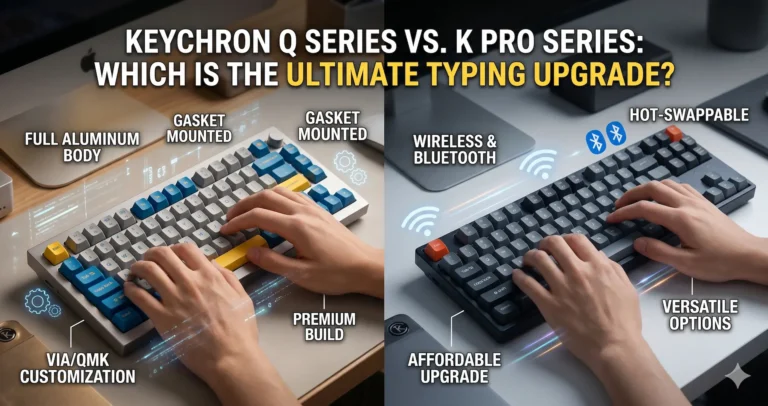
10. Keychron Q15 Max & Q Pro Series: The Unshakeable Baseline
Keychron has ruthlessly flooded the market with every conceivable layout, from the Alice-style ergonomic boards to massive 100% full-size arrays. In 2026, the Q Max series—specifically the highly unique ortholinear Q15 Max and the staple Q1 Pro—serves as the absolute benchmark for premium pre-built mechanical keyboards.
Consistency Over Innovation
Featuring full CNC aluminum cases, double-gasket designs, and highly reliable multi-device wireless capabilities, the Q Max boards are incredibly heavy, stable, and dependable. When paired with Gateron Jupiter Banana or Baby Kangaroo switches, they produce a distinctively clacky, somewhat rigid sound profile.
The Verdict
Honestly, the Keychron Q series has become slightly boring. It completely lacks the acoustic magic of the Mode Crown Mount or the boundary-pushing split plates of the Wuque Studio Freya. The stock sound tends to lean heavily toward a sharp, sometimes thin clack, rather than the deep, marbly thock that modern enthusiasts crave. However, the Q series works flawlessly out of the box, supports QMK/VIA without a single complaint, and provides an immaculate, indestructible aluminum canvas for future modifications. It is the safest, most reliable recommendation in the entire hobby.
The Acoustic Physics of Tactility in 2026
To fully appreciate these ten keyboards and why they feel the way they do, one must understand how acoustic physics interplay with tactile switch design. In 2026, the community vocabulary for keyboard sound has become highly specific, bordering on a science. The interaction between the switch’s stem pole length, the bottom housing material, the plate material, and the internal case foams strictly determines whether a board produces a “Clack,” a “Thock,” a “Creamy,” or a “Poppy” sound.
- Thock: Achieved using deep-sounding switches (like the Boba U4T), thick polycarbonate (PC) or POM plates, and incredibly dense case foams. The sound is low-frequency, bass-heavy, and heavily muted.
- Clack: Achieved using long-pole switches (like the Sillyworks Type R), rigid aluminum or carbon fiber plates, and minimal to zero case foam. The sound is high-frequency, sharp, and crisp.
- Creamy / Marbly: Achieved using heavily factory-lubed switches (like the Gateron Baby Kangaroo), FR4 plates, and PE foam sheets placed directly beneath the switches to alter the frequency. The sound is mid-pitch, smooth, and highly resonant.
- Poppy: Achieved using switches with modified nylon or PA12 top housings (like the HMX Black Cat) and absolutely no case foam. The sound features a distinct, snappy top-out collision as the stem returns to the housing.
When building a tactile keyboard, the plate material directly alters the physical perception of the tactile bump. Rigid plates (Aluminum, Brass, Carbon Fiber) do not flex during the keystroke. Therefore, the entirety of the kinetic force is directed straight back into the user’s fingertips, making the tactile bump feel significantly sharper, heavier, and more pronounced.
Conversely, flexible plates (Polycarbonate, POM, Polypropylene) bow slightly under the pressure of the typist’s fingers. This microscopic flex absorbs the kinetic energy of the bottom-out, effectively softening the tactile bump and providing a much more cushioned, less fatiguing experience.
This is exactly why the split-plate design of the Wuque Studio Freya Ultra is so revolutionary. By isolating the stiff perimeter stabilizers on an aluminum frame from the soft, cushioned alpha cluster on a polycarbonate frame, it offers the absolute best of both physical and acoustic worlds. It is engineering brilliance applied to a highly subjective sensation.
Conclusion: The State of the Endgame
The concept of an “Endgame” keyboard has always been a complete myth, a moving target perpetually displaced by the next group buy, the next Kickstarter campaign, or the next switch innovation. Yet, the keyboards of 2026 have undeniably raised the absolute floor of what is considered acceptable in the premium space.
This deep dive indicates that true innovation has shifted away from aggressive exterior chassis designs and firmly toward internal acoustic architecture. The Mode Encore’s Crown Mounting System proves that engineers are finally addressing the inherent flaws of standard PORON gasket mounts, finding brilliant mechanical ways to isolate vibration without compromising the rigidity required for crisp tactile feedback. Meanwhile, the staggering, sometimes infuriating complexity of the Meletrix Zoom65 V3 demonstrates a market that fully embraces hyper-modularity, even if the execution is sometimes compromised by fragile components.
For the tactile switch enthusiast, the market has never been more vibrant. The massive shift toward early-actuating, long-pole stems has created a typing experience that is highly responsive, acoustically vibrant, and significantly less fatiguing than the heavy tactile switches of five years ago. Whether one chooses to endure the frustrating software of the Razer BlackWidow V4 Pro, navigate the delicate Maglev magnets of the Zoom65 V3, or pay the deeply exorbitant aftermarket premiums for a Keycult No. 3, the tools for achieving absolute tactile perfection are readily available.