Why Is My Typing Speed Stuck at 40 WPM? (7 Hidden Reasons)
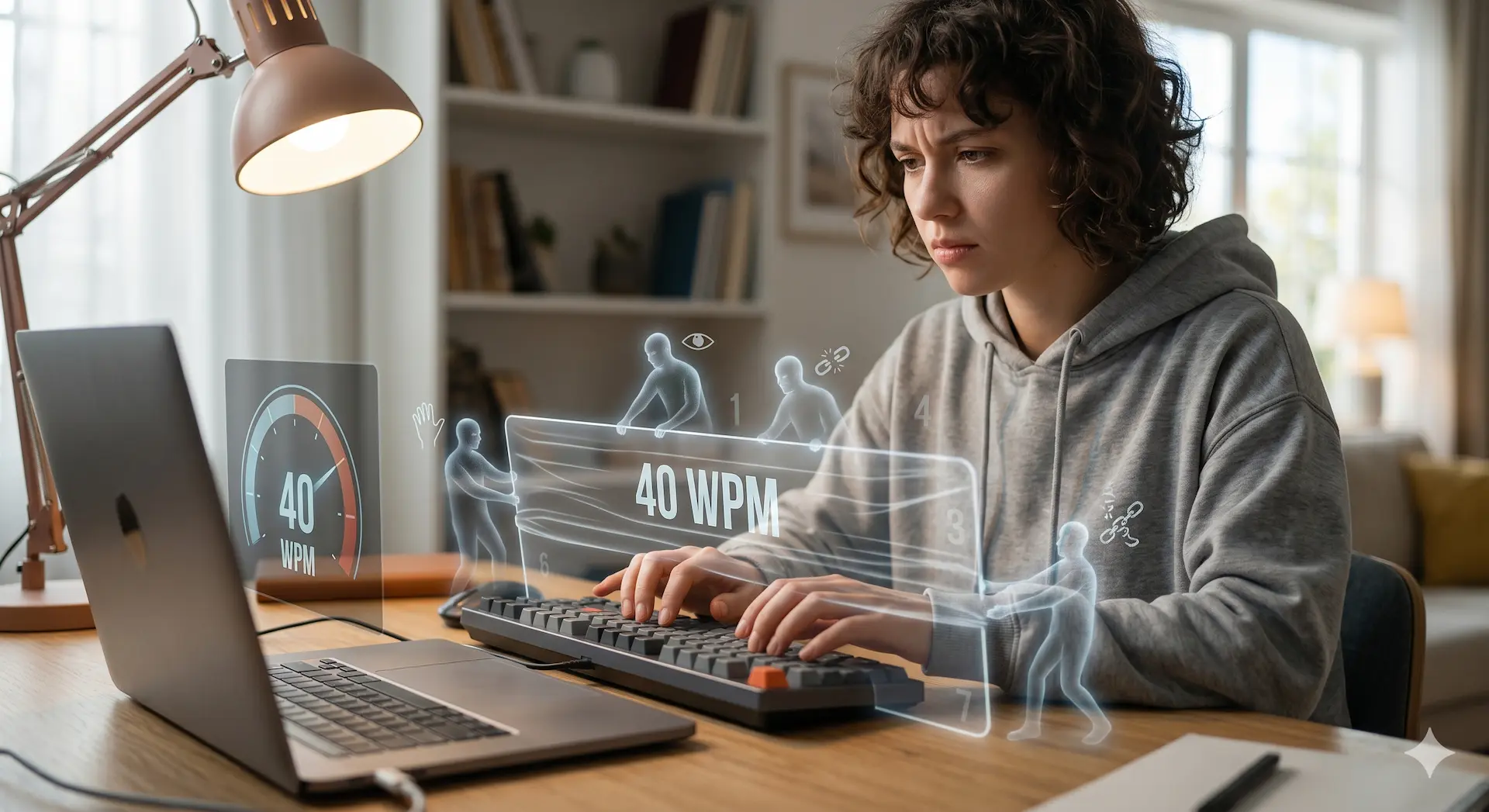
I used to think hitting 40 words per minute meant I made it. For a while, I was proud — my fingers were finally faster than hunt-and-peck mode, my typos were manageable, and I could keep up in chats. But then I noticed something frustrating: no matter how much I practiced, my typing speed stayed there. Week after week, 40 WPM. Sometimes 42 on a good day. Back to 39 on a bad morning. 40 WPM being the common average for most of the times.
If you’ve been typing for months or even years for that matter and feel stuck around that mark, I’ve been exactly where you are. And no — the solution isn’t just “practice more.” In fact, practicing without fixing what’s holding you back can make your habits worse.
After years of testing different techniques, tools, and useful tricks, I realized there are a few sneaky reasons our typing speed stalls — and most typing tutorials your find usually never talk about them. Let’s dig into them one by one.
1. You’re Practicing the Wrong Way
Here’s the thing: typing isn’t just about speed, it’s about muscle memory — the same way playing a piano piece smoothly isn’t about hitting the notes as fast as possible the first time.
For the longest time, I thought practicing longer was the fix. I’d open a typing test site and do 20 rounds in a row, thinking more = better. But all that did was reinforce my existing habits — the good and the bad.
The right way to practice is to focus on deliberate correction. That means slowing down just enough to notice what’s tripping you up — maybe it’s a certain pair of letters like “th” or “ly,” or your left pinky keeps missing the “A.”
When you slow down, your brain actually rewires those movements properly. Once they’re clean, the speed catches up naturally. Ironically, the fastest way to increase your WPM is to stop thinking about speed for a little while.
Honestly, this was hard for me. Slowing down felt like failure at first, but I swear, after a week of focused slow-typing and key accuracy drills, I broke 50 WPM for the first time in months.
2. Your Posture and Keyboard Are Working Against You
This one sounds minor until you experience it. If your wrists hurt, your shoulders are tense, or your keyboard feels even slightly uncomfortable, your fingers won’t flow naturally. Every tiny discomfort adds micro‑hesitation.
I used to type with my laptop keyboard flat on the desk, slouched over like a gargoyle. It “worked,” but I constantly felt cramped after long sessions. Once I switched to an external mechanical keyboard angled up slightly, it was a night‑and‑day difference — smoother motion, faster reaction, less effort.
Small setup tweaks that can make a big difference:
- Adjust your chair so your elbows are at a right angle.
- Keep wrists straight; use a wrist rest if needed.
- Don’t rest your palms too hard — light touch is faster.
- Experiment with different keyboard heights and key switches.
If you haven’t customized your setup, you may literally be fighting physics every time you type.
3. You’re Tensing Up Without Realizing It
Ever noticed your shoulders creeping up toward your ears during a long typing session? Or your jaw clenching as you try to beat your high score? Yeah, that tension is killing your speed.
Typing well is all about rhythm. When your hands, wrists, and shoulders are tense, your movements become sharp and jerky. You end up over‑pressing keys, missing letters, and fumbling.
What worked for me was occasionally stopping mid‑test and scanning my body: Am I breathing normally? Are my fingers relaxed? Is my hand hovering lightly over the keys or pressing into them?
Now I treat typing like a flow exercise. You can’t get into flow if your body’s in fight‑or‑flight mode. So, before a focused practice session, I literally roll my shoulders, shake out my hands, and take one deep breath.
Sounds silly, but try it — tension is a hidden speed thief.
4. You Haven’t Learned to Stop Fixing Every Mistake
This one frustrated me more than anything. I was obsessed with keeping my accuracy perfect. Every time I mistyped a single letter, I’d hit backspace immediately. The result? My rhythm broke every five seconds, and I never built momentum.
Here’s the truth: real speed comes from rhythm, not from perfection.
Once I trained myself to keep going — even through typos — my speed jumped overnight. Sure, my accuracy dropped temporarily, but I learned to trust my overall typing flow. After a few weeks, my accuracy naturally balanced out again, but my WPM stayed higher.
If you’re stuck at 40 WPM, check if you’re subconsciously breaking rhythm to fix micro‑errors. The fastest typists don’t type perfectly. They’re just consistent enough that their mistakes barely matter in the big picture.
Honestly, learning to “let the typos go” was one of the hardest mental shifts for me. But it’s worth it.
5. Your Brain Is Ahead of Your Fingers (or Vice Versa)
Sometimes the problem isn’t your hands at all — it’s your brain pacing mismatch.
Here’s what I mean: when you type passages from books or random word tests, you’re processing unfamiliar patterns. But when you type your own thoughts (like journaling or chatting), your brain might fire faster than your fingers can move. That disconnect makes you feel “stuck,” because typing tests don’t reflect how you naturally type in real life.
Or it goes the other way: your fingers move faster than your mental comprehension of the next word, so you pause mid‑sentence to think.
That lag time can eat away at speed without you realizing it.
One trick that helped me: separate “thinking typing” from “mechanical typing.”
- Do pure typing drills (random words, quotes, etc.) to train finger speed.
- Then do journaling sessions focused on thought flow.
This way you train both muscle memory and mental pacing. Eventually, they sync up — and that’s when you start breaking your plateau.
6. You’re Practicing in Short Bursts, Not Longer Sessions
Here’s something I learned from music practice: your brain needs sustained engagement to form strong neural connections.
Five minutes here, ten minutes there — that kind of fragmented practice keeps you from entering flow or noticing subtle habits. Once I started practicing for longer 20‑minute blocks (with short breaks), my muscle memory improved drastically.
Typing speed isn’t a “daily habit” kind of skill like brushing your teeth — it’s a performance skill. You need focused sessions where your body learns small refinements: finger stretching, rhythm, reaching unusual key combos.
Pro tip: record your best runs once or twice a week. If you notice you always mess up on words like “through” or “because,” isolate them and drill them separately. It’s less about total time spent and more about concentrated improvement.
7. You’re Bored (and Your Practice Is Repetitive)
This might sound too psychological to matter, but typing is deeply affected by your mental state.
When practice gets boring, your brain goes lazy. You lose focus, your accuracy drops, and your muscle memory stops developing.
I used to run the same test paragraph on Monkeytype over and over. I could type it from memory. Guess what that trained? Memorization — not typing.
When I switched to typing different content — random quotes, song lyrics (in my head, not copied from the internet), even coding snippets — suddenly, I was alert again. The variety reignited the challenge.
Sometimes what feels like a physical plateau is actually a mental burnout plateau.
Change your environment:
- Try a different typing site or layout.
- Switch languages or word lists.
- Add music for pacing.
- Compete with friends if that motivates you.
Anything that makes you re‑engage cognitively helps unlock progress.
The Underlying Truth: Typing Speed Is a Mirror of Your Attention
At its core, typing well is about presence. Your brain, eyes, and hands need to sync in real time. If your mind’s drifting — thinking about dinner, or checking your phone between tests — you’ll stall.
I realized my best sessions always happened late at night, headphones on, fully zoned in. That’s when I wasn’t thinking about WPM at all — just feeling the text flow through my fingers. Those sessions pushed me from 40 to 60 to 80 WPM over time.
So much of speed comes down to being deeply engaged with what you’re typing.
If you’re critical of yourself for “being stuck,” take that same attention and redirect it into curiosity: What exactly feels off? That mindset shift alone can break a plateau.
A Quick Reality Check: Don’t Compare Your Typing Speed to Others
Typing speed comparisons online can really mess with your motivation. Seeing someone hit 120 WPM can make your 40 feel like crawling, but it’s not a race.
Your typing speed is contextual — what you type, how often, your style, your setup — all of it matters. A novelist might “type slower” but produce paragraphs of clean, thoughtful text. A gamer who types chat messages faster isn’t necessarily more skilled in structured writing.
Think of typing speed like running pace. Sure, sprint speed looks flashy, but most real work happens at a comfortable jog. Sustainable speed is what matters. Accuracy, rhythm, and comfort beat raw speed any day.
Bonus Section: How I Finally Broke My 40 WPM Plateau
I’ll be real — it took me about a month to get unstuck, and about three to feel truly confident above 70 WPM. Here’s exactly what I did:
- Stopped chasing speed. I focused only on hitting 98–99% accuracy for a week.
- Switched to touch typing full‑time. Even if I was slower at first.
- Rebuilt my keyboard setup. Got an external keyboard with lighter switches and a wrist rest.
- Did warm‑ups. Literally typing nonsense words for 3 minutes before real tests.
- Watched hand placement videos. Painful but eye‑opening — my fingers were all over the place.
- Used music to train rhythm. Kept a steady background beat while typing.
- Stopped comparing. I focused on my own metrics week over week.
I went from 40 to 55 WPM in two weeks. By the end of two months — around 75 WPM average. No gimmicks. Just smarter practice.
What You Can Do Starting Today
Here’s my two‑minute game plan to start breaking your typing plateau:
- Run one typing test (choose a random word list, 1 minute).
- Look for your main error patterns. Which letter pairs or words slow you down?
- Drill just those combos for 5–10 minutes, slowly and perfectly.
- Practice one focused 20‑minute session daily, instead of 10 random short tests.
- Review weekly progress — accuracy % and WPM separately.
- Change content sources to keep practice exciting.
Tiny refinements add up faster than marathon typing sessions ever will.
Final Thoughts
If you’re stuck at 40 WPM, that doesn’t mean you’re not improving — it just means your body’s reached the top of its lazy learning curve. That’s actually great news, because now you have awareness.
Once you fix your habits — posture, tension, rhythm, mindset — speed naturally compounds.
Honestly, the biggest myth about typing speed is that it’s about “fast fingers.” It’s not. It’s about smart repetition, relaxation, and rhythm.
So keep at it. Slow down to move faster.
There will be a day — maybe soon — when your 40 WPM self feels like ancient history.