The Content Heavy Writer’s Favourite: Why the ‘Feel’ of a Mechanical Keyboard Changes Your Entire Workday
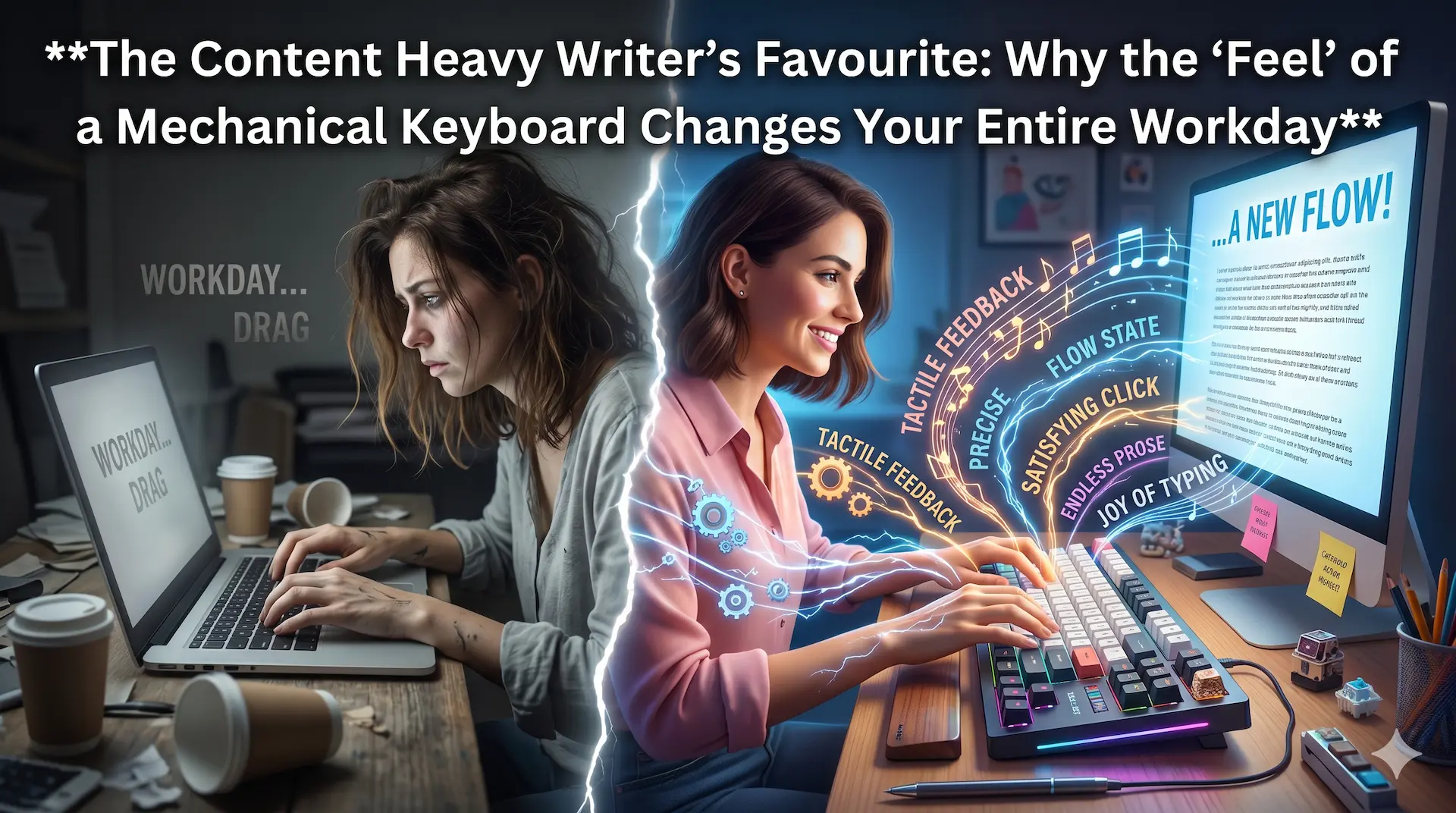
Have you ever sat down at your desk, ready to pour your heart into a new project, only to feel like you’re typing on a damp sponge? That “mushy” feeling of a standard membrane keyboard isn’t just a technical flaw—it’s a mood killer. For those of us who live by our words, the keyboard is the bridge between our thoughts and the screen. When that bridge feels flimsy, your productivity suffers. A mechanical keyboard isn’t just an upgrade; it’s a sensory experience. It’s the difference between driving a budget hatchback and a finely tuned sports car. The weight, the sound, and that crisp “snap” under your fingertips send a signal to your brain: “It’s time to create.” It’s an emotional shift that turns a chore into a craft.
Which is better to start with! No wasting time here
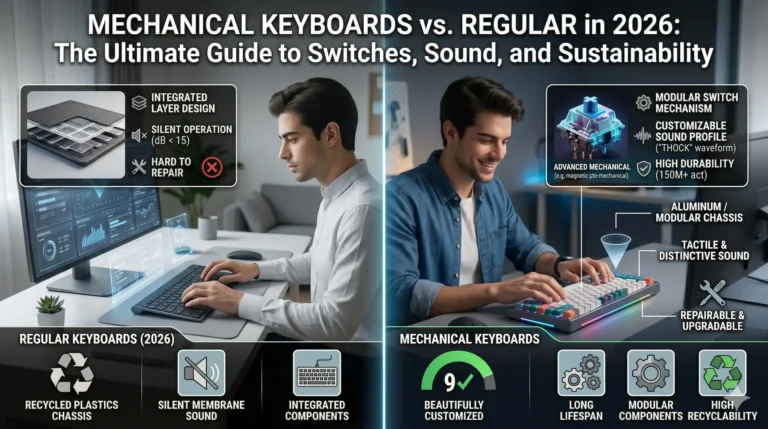
If you are looking for the “quick answer,” here is my honest comparison. A regular keyboard is a utility—it’s cheap, quiet, and disposable. A mechanical keyboard is an investment—it’s durable, serviceable, and deeply personal.
From a technical standpoint, the “Serviceability Score” of a mechanical board is infinitely higher; if a switch fails, one can fix it, you don’t bin the whole unit. Emotionally, the “Pre-Purchase” phase is often filled with hesitation about the price (the “is it worth it?” phase). However, “Post-Purchase” and during use, that 10% emotional boost is what keeps you at your desk. You feel a sense of pride seeing it sit next to your laptop; it looks professional, feels “extra-sturdy,” and gives you rhythmic feedback that actually reduces typing fatigue. If you write for a living, your hands deserve the clarity of a physical switch.
The Science and Soul of the Switch
To truly understand why the “feel” changes your workday, we have to look at what’s happening under the keycap. A standard keyboard uses a rubber dome—you have to “bottom out” the key (press it all the way down) for it to register. This is where the fatigue comes from. Mechanical keyboards, however, use individual physical switches with an “actuation point.”
The Engineering Strength
Most high-quality mechanical boards are built on a metal frame. This means when you type, the board doesn’t flex. This stability provides a consistent “landing” for your fingers, which is why these boards last for 50 million keystrokes compared to the 5 million of a membrane. It survives the Indian dust and heat because you can actually maintain it.
The Emotional Presence
But beyond the specs, there is the “Desk Presence.” Next to a sleek laptop, a mechanical keyboard adds a layer of authority to your setup. There is a psychological “Status Symbol” attached to it, yes, but it’s mostly for you. It’s the satisfying “click” (or the smooth “thud” of a Brown switch) that creates a rhythmic flow. You start to associate that sound with being “in the zone.” Before you buy, you worry about the cost; once you start using it, you wonder how you ever worked without that tactile confirmation that your ideas are being recorded. It’s about moving from a “disposable” mindset to a “legacy” tool.
The Engineering of Excellence—Durability, Design, and the Typist’s Flow
When you look at a standard keyboard, you are looking at a mass-produced “membrane”. They are designed to be cheap, but they are not designed to last.
A mechanical keyboard is fundamentally different. It is a collection of individual precision instruments. Every single key has its own housing, spring, and physical switch.
- The Actuation Advantage: On a regular board, you must press the key all the way down to the “mushy” bottom to register a letter. Mechanical switches have an “actuation point”—a mid-way mark where the command is sent.
- The Fatigue Factor: Because you aren’t slamming your fingers against a hard plastic base hundreds of thousands of times a day, the physical strain on your tendons is significantly reduced.
- The Emotional Feedback: There is a deep, psychological satisfaction in that “click” or “thud”. It is a tactile confirmation that your thought has been successfully captured by the machine. It turns the act of typing from a silent struggle into a rhythmic performance.
Built for the Indian Context: Dust, Humidity, and Resilience
After five years of observing how electronics behave in our local environment, I can tell you that dust is the silent killer. A regular keyboard is a “closed box”; once dust gets under those rubber domes, the keys become sticky or unresponsive, and there is almost nothing you can do.
Mechanical keyboards are built for the long haul in Indian conditions:
- Deep-Cleaning Capability: The keycaps on a mechanical board are designed to pop off. This allows you to perform a “deep-clean” that simply isn’t possible with membrane boards. You can keep your tool in 100% working condition even after years of use in dusty environments.
- The “Extra-Sturdy” Chassis: Most high-end mechanical boards are built on a heavy metal or reinforced plastic plate. This gives the board a physical weight that prevents it from sliding around your desk. Emotionally, this weight translates to a feeling of “authority” and “professionalism”.
- Spill Management: While no electronic device loves water, the individual unit design of mechanical switches means a small spill doesn’t always short the entire system. Some models even feature “drainage holes” in the manual specs specifically for these accidents.
The Serviceability Score: Why Repairable is Respectable
We live in a world of “disposable” tech, but a mechanical keyboard is an “investment”.
- Individual Replacement: If your ‘A’ key stops working on a membrane board, you throw away the whole unit—a waste of money and a burden on the landfill. With a mechanical board, a technician (or even you, with a little guidance) can replace that one single switch.
- Customization (The Status Factor): You can change the keycaps to match your aesthetic. Whether you want a professional look for the office or a vibrant setup for your home studio, the keyboard grows with you. This creates a “post-purchase” pride that a cheap plastic keyboard can never offer.
The Sound of Productivity: Finding Your Acoustic Signature
People often worry that mechanical keyboards are too loud. In my manual deep-dives, I’ve found that there is a switch for every ear.
- Blue Switches: The “clicky” choice. They provide the most feedback and are loved by writers who work alone and enjoy the rhythmic “sound of progress.”
- Brown Switches: My personal recommendation for most. They provide that tactile “bump” without the loud click, making them polite for shared office spaces.
- Red Switches: Smooth and linear. These are often the choice for those who want speed and silence.
Comparison at a Glance: The Perspective
| Feature | Regular (Membrane) Keyboard | Mechanical Investment |
| Internal Build | Layered plastic and rubber | Metal/Reinforced plate and individual switches |
| Typical Lifespan | 5–10 million keystrokes | 50–100 million keystrokes |
| Repairability | Near Zero (Disposable) | High (Serviceable) |
| Emotional Impact | “Utility” – Just a tool | “Legacy” – A professional companion |
| Indian Conditions | Vulnerable to dust/heat | Easy to maintain and deep-clean |
The Expert’s Insight: > When you buy a mechanical keyboard, you are paying for the 90% engineering and the 10% soul. Pre-purchase, the price might give you a moment of hesitation. But post-purchase, every time you sit at your desk and feel that “extra-sturdy” presence, you realize you haven’t just bought a peripheral—you’ve upgraded your daily interaction with your work. It is a “Status Symbol” not for others to see, but for you to feel.
Finding Your Perfect Match: The ‘Feel’ Test
Choosing a keyboard is deeply personal. While the website specs give you the numbers, the “feel” in your hand is what determines your daily happiness.
- The Office Professional: If you work in a shared space, I always recommend looking for Brown switches. They provide that crisp, tactile “bump” you crave without the loud “clicky” sound that might disturb your colleagues.
- The Creative Loner: If you have a private studio, go for the Blue switches. The rhythmic “sound of progress” creates an incredible emotional flow that makes you feel like a master of your craft.
- The Speedster: For those who want the smoothest experience with zero resistance, Red switches are the way to go, offering silence and speed.
A Final Word’
As we’ve discussed, a mechanical keyboard is a “legacy” tool. Pre-purchase hesitation about the price is normal, but post-purchase pride is guaranteed. When you see that “extra-sturdy” chassis sitting next to your laptop, it adds a layer of authority to your setup that a disposable plastic unit simply cannot match. It is a status symbol for your own senses.
The ‘Serviceability’ Promise
Remember the Serviceability Score. In our Indian conditions of dust and heat, you need a tool that can be maintained. Whether it’s popping off keycaps for a deep-clean or replacing a single failed switch instead of the whole unit, this investment is built to stay out of the landfill and on your desk for years to come.