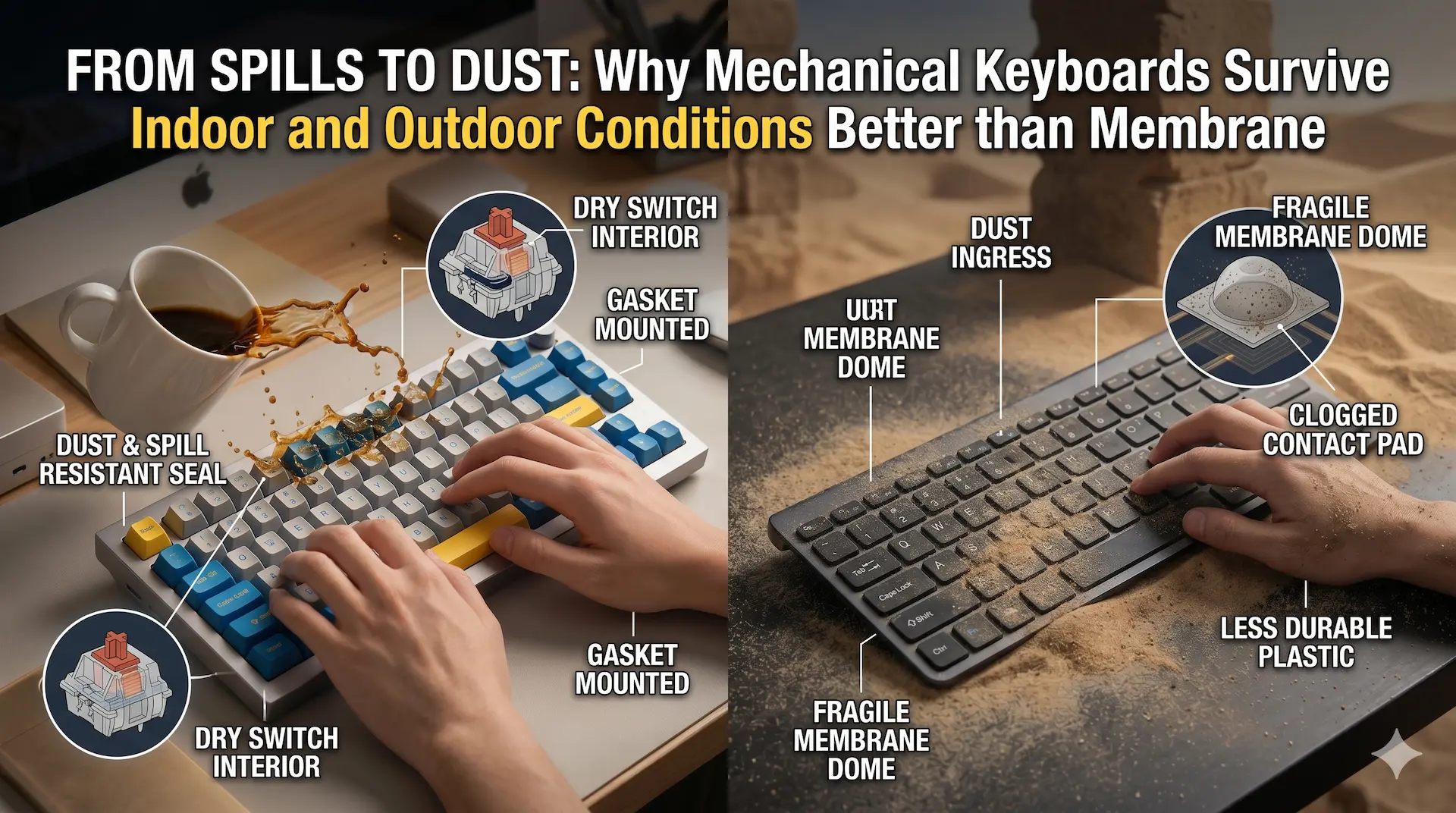
From Spills to Dust: Why Mechanical Keyboards Survive indoor and outdoor Conditions Better than Membrane
We have all been there. You are deep in a flow state, your favorite beverage is sitting just an inch too close to your hands, and then—splash. A standard membrane keyboard handles a liquid spill about as well as a smartphone handles a swimming pool. Because membrane keyboards rely on a single, continuous sheet of delicate electrical plastic, a tiny drop of moisture can short out the entire board. Suddenly, your “A” key is typing “7,” or the whole device simply goes dark. It is a frustrating, expensive, and avoidable disaster in many ways.
But life in 2026 isn’t just about indoor spills. With more people taking their “offices” outdoors, work from home parks and other places, we are facing a new type challenge: the elements. Fine dust, pollen, and even stray crumbs act like sandpaper inside a regular keyboard. While a membrane board traps this grit against its sensitive sensors, a mechanical keyboard is built differently. It is a collection of individual, self-contained “engines” (the switches). This fundamental design difference is why mechanical keyboards aren’t just for enthusiasts—they are for anyone who lives a real, messy, unpredictable life. Let’s look at why these “clicky” tanks are the champions of survival.
Sheet vs. Switch
To understand why a mechanical keyboard can survive a sandstorm while a membrane keyboard gives up from a single crumb, we have to look at how they are built.
Imagine a membrane keyboard as a three-layer plastic sandwich. These layers are extremely thin and run across the entire length of the board. When you press a key, you are pushing those layers together to complete an electrical circuit. Because these layers are so large and interconnected, a single point of failure—like a drop of water or a piece of grit—can ruin the connection for multiple keys or the entire device. There is no “armor” protecting the sensitive parts; the plastic skin is the sensitive part.
A mechanical keyboard, on the other hand, is a collection of independent “fortresses.” Each key has its own self-contained switch. If you imagine your keyboard as a city, a membrane board is a single building where one leak in the roof floods every floor. A mechanical board is a row of separate houses. If one house gets a leak, the others stay perfectly dry and functional.
The “Spill Factor”: Liquid Management in 2026
Spills are the number one cause of keyboard death. In a typical home or office setting, coffee, tea, and water are constantly hovering over our tech.
Why Membranes Fail the “Sip Test”
When you spill coffee on a standard keyboard, the liquid seeps between the layers of the membrane. Because these layers are pressed tightly together, capillary action sucks the liquid deep into the center of the board. Once it’s in there, it’s almost impossible to get out. Even if you let it dry, the sugar or minerals left behind create a sticky residue that permanently bridges the electrical connections. Your “Enter” key might start acting like it’s being held down forever, or your “Shift” key might stop working entirely.
The Mechanical Defense
In 2026, mechanical keyboards have two major defensive advantages against liquids:
- Raised Switches (The Umbrella Effect): On most modern mechanical boards, the switches sit slightly above the “plate” of the keyboard. The keycaps act like umbrellas. If you spill water, most of it hits the keycap and runs off onto the plate, away from the actual internal electronics.
- Drainage and Isolation: Many 2026 models include “drainage holes.” Liquid passes through the board and out the bottom without ever touching the circuit board (PCB). Even if liquid does get into a switch, you aren’t doomed. Because the switches are individual units, you can often just replace that one sticky switch for a few cents rather than throwing away a $100 keyboard.
The Battle Against Dust, Pollen, and Grit
In 2026, the “outdoor office” has become a reality for many. Whether you’re working from a balcony, a park bench, or a dusty cafe patio, your keyboard is fighting a constant war against particles.
The Clog Problem
On a membrane or “chiclet” (laptop-style) keyboard, the clearance between the key and the frame is tiny. When a speck of dust or a grain of sand gets in there, it gets trapped. Because there is very little vertical movement, that tiny grain can prevent the key from registering at all. If you’ve ever had a laptop key feel “crunchy” or stop working after a trip to the beach, you’ve experienced this.
Mechanical Resilience
Mechanical switches have much more “travel”—the distance the key moves up and down. This extra space makes it much harder for dust to “jam” the mechanism. Furthermore, the 2026 generation of Dust-Proof Switches features a specialized “box” stem design. This is a physical wall that surrounds the internal parts of the switch, making it nearly impossible for dust, pet hair, or pollen to enter the housing where the electrical contact happens.
Hall Effect Switches: The Ultimate 2026 Game Changer
If you really want to talk about “outdoor survival,” we have to talk about Hall Effect (Magnetic) switches. These have become the gold standard in 2026 for durability.
Traditional mechanical switches use two pieces of metal hitting each other to send a signal. Over time, moisture in the air can cause these metal bits to “oxidize” (get a tiny bit of rust), which leads to keys failing.
Hall Effect switches use magnets and sensors instead of physical metal contacts. Since nothing is actually touching, there is no metal to corrode. You could theoretically use a Hall Effect keyboard in a humid, salty beach environment for years, and it would never “wear out” or fail due to rust. For the outdoor enthusiast, this is the equivalent of having a waterproof watch versus a standard one.
The Maintenance Advantage: The “Deep Clean”
One of the most overlooked “basic” things about mechanical keyboards is how easy they are to clean. This is a massive survivability factor.
- The Membrane Nightmare: To clean a regular keyboard, you usually have to use a can of compressed air and hope for the best. You can’t take the keys off without risking breaking the fragile plastic clips. Most people just live with the “grime” until the keyboard feels too gross to use, then they buy a new one.
- The Mechanical “Wash Day”: With a mechanical board, you can pop every single keycap off using a simple tool. You can throw the plastic keycaps into a bowl of warm, soapy water, scrub the metal plate of the keyboard with a brush, and have a “brand new” device in 20 minutes.
This ability to perform a factory-level clean at home means the keyboard doesn’t just survive—it stays hygienic and pleasant to use for a decade or more.
Material Science: PBT vs. ABS in the Sun
If you work outdoors, you’ve likely seen old plastic electronics turn yellow or get “shiny” and greasy. This is caused by UV rays and skin oils breaking down the plastic.
In 2026, most high-quality mechanical keyboards use PBT (Polybutylene Terephthalate) keycaps. Unlike the ABS plastic used in regular keyboards and laptops, PBT is:
- Heat Resistant: It won’t warp if you leave it in a hot car or in direct sunlight on your porch.
- UV Stable: It won’t turn that ugly “old computer yellow” after a summer of outdoor use.
- Texture Retentive: It doesn’t get that “greasy shine” that makes membrane keyboards look dirty even when they are clean.
The Portability Pain Point: Why It Doesn’t Snap
Finally, let’s talk about the physical “toughness” of moving your gear. Regular keyboards are thin and prone to flexing. If you cram a membrane keyboard into a backpack, the pressure can cause the internal plastic layers to rub together, leading to “dead zones” where keys stop working.
Mechanical keyboards are built on a metal or thick plastic frame (the plate). They are rigid. You can drop a mechanical keyboard into a bag with your laptop, a charger, and a water bottle, and the “structural integrity” of the board protects the electronics inside. The keys are reinforced by thick plastic stems that are much harder to “snap off” than the tiny, scissor-thin hinges found on laptops.
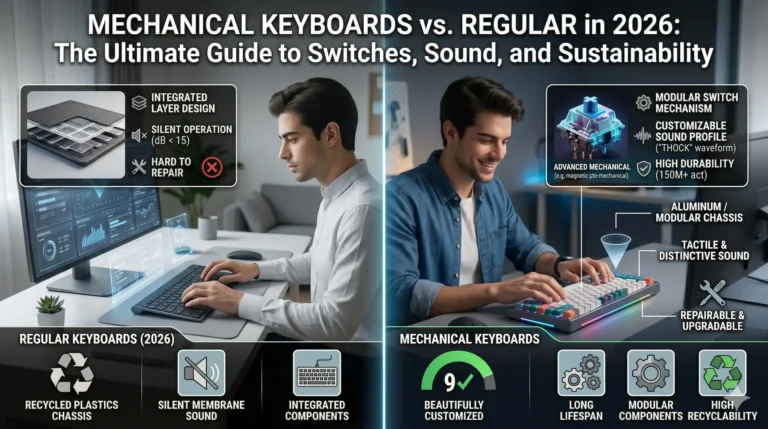
Real-World Comparison Table
| Feature | Membrane Keyboard | Mechanical Keyboard (2026) |
| Spill Survival | Very Low (Short-circuits easily) | High (Individual switches & drainage) |
| Dust/Sand Resistance | Low (Jams the thin mechanism) | High (Box-stem & Hall Effect tech) |
| Cleaning Ease | Difficult (Cannot remove keys safely) | Easy (Fully detachable parts) |
| Sun/Heat Exposure | Prone to warping/yellowing | PBT plastic stays like new |
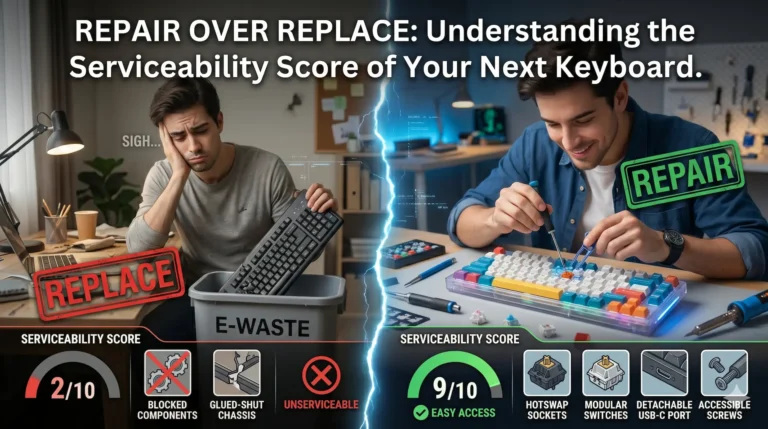
| Repairability | Non-existent (Disposable) | High (Swap one switch at a time) |
The Long-Term “Financial” Survival
Beyond physical survival, there is the survival of your wallet. In 2026, the “Buy It For Life” movement is huge. A membrane keyboard is a $30-50 purchase that you will likely repeat every 2 years because of a spill, a broken key, or just “crunginess.”
A mechanical keyboard is a $150 investment that lives through your coffee spills, your outdoor adventures, and your house-moves. When you look at the “Basic” reality of daily life, the keyboard that can be washed, repaired, and reinforced is the only one that actually saves you money over a five-year period. It’s not just a hobbyist’s toy; it’s a rugged tool built for a messy world.
Conclusion: Choosing the Survivor
At the end of the day, the choice between mechanical and membrane comes down to how much you trust your environment. If you live in a perfectly sterile, dust-free lab and never drink liquids, a membrane board might serve you just fine. But for the rest of us—who balance coffee mugs, open windows to the breeze, and occasionally work from a dusty park bench—the mechanical keyboard is the only logical choice. It is an investment in peace of mind. You aren’t just buying a tool for typing; you’re buying a survivor that handles the chaos of daily life without breaking a sweat.