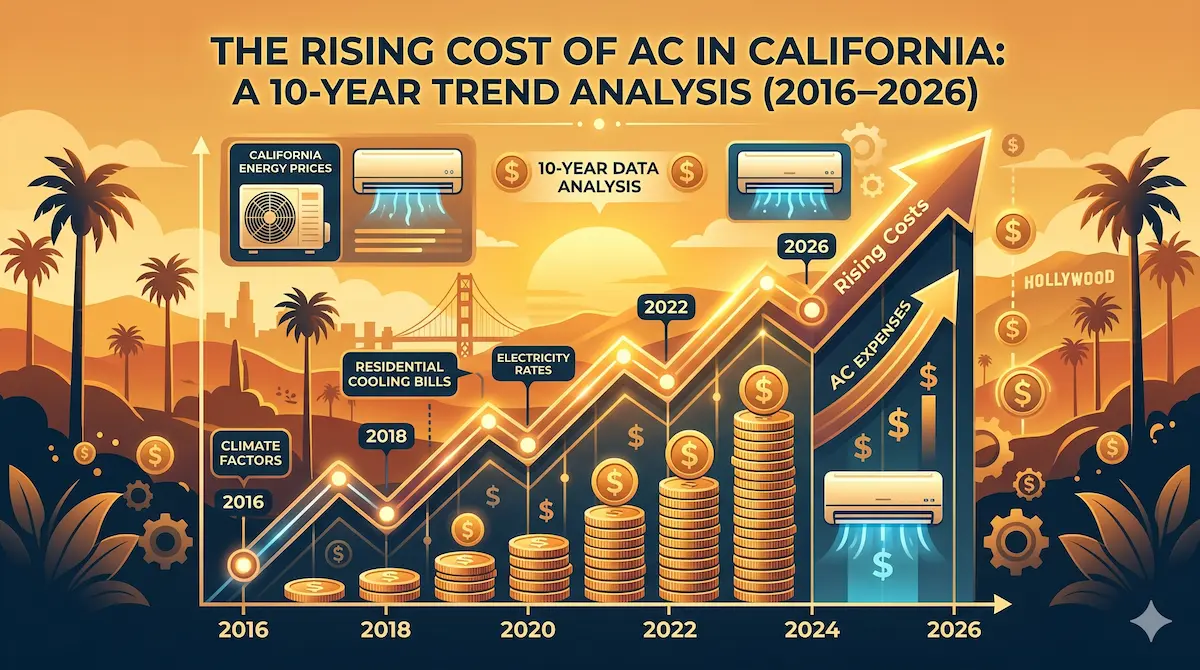
The Rising Cost of AC in California: A 10-Year Trend Analysis (2016–2026)
If you’ve requested a quote for a new air conditioning system in California recently, you might have experienced a severe case of sticker shock. Over the past decade, the cost of cooling a home in the Golden State has transformed dramatically. What was once considered a moderate home improvement expense has now become one of the most significant investments a homeowner can make.
As we sit firmly in 2026, looking back over the last ten years reveals a perfect storm of economic shifts, rigorous environmental regulations, supply chain overhauls, and changing climate patterns that have driven HVAC (Heating, Ventilation, and Air Conditioning) costs to record highs. In this comprehensive 10-year trend analysis, we will explore exactly why AC costs in California have surged, how regional differences impact your wallet, and what you can do to navigate this expensive landscape.
The Baseline: Where We Started in 2016
To understand the current market, we must first look back at the HVAC landscape of 2016. A decade ago, the economy was stable, supply chains were highly predictable, and the regulatory environment was far less stringent than it is today.
In 2016, a typical California homeowner looking to replace a standard 3-ton central air conditioning system (including both the condenser and the indoor coil) could expect to pay between $4,500 and $6,000 fully installed. At that time, the minimum efficiency standard in California was SEER 14 (Seasonal Energy Efficiency Ratio). R-410A refrigerant, which had just become the industry standard after the phase-out of the ozone-depleting R-22 (Freon), was cheap and widely available.
Labor rates were also considerably lower. Experienced HVAC technicians were easier to find, and installation companies charged hourly rates that reflected a less constrained labor market. For many residents living near the coast—such as in San Francisco, Santa Monica, or San Diego—central AC was still considered a luxury rather than an absolute necessity.
The Catalyst: 4 Major Drivers of Cost Increases (2020–2026)
Between 2016 and 2026, the cost of a standard AC replacement roughly doubled, and in some high-efficiency scenarios, tripled. This massive price inflation didn’t happen overnight. It was driven by four critical factors:
1. The Global Supply Chain and Inflationary Pressures
The turning point occurred in 2020 during the global pandemic. Factory shutdowns worldwide led to massive shortages in raw materials essential for HVAC manufacturing, primarily copper, aluminum, and steel. Furthermore, modern air conditioners rely heavily on semiconductor chips for their control boards, which faced historic global shortages.
Even as supply chains stabilized in 2023 and 2024, general economic inflation took hold. Manufacturers like Carrier, Trane, and Lennox passed their increased manufacturing and logistics costs down to the distributors, who then passed them on to the local contractors, and ultimately, the homeowner.
2. Stringent Environmental Regulations (SEER2 Mandate)
California has always led the nation in environmental policy, but the shift on January 1, 2023, was monumental. The Department of Energy rolled out the SEER2 (Seasonal Energy Efficiency Ratio 2) standards. Under the new testing protocols, air conditioners had to meet much stricter efficiency guidelines to be legally sold and installed in the Southwest region (which includes California).
To meet SEER2 compliance, manufacturers had to redesign their equipment, incorporating larger coils and more advanced variable-speed compressors. This forced redesign instantly added 15% to 25% to the base cost of the equipment.
3. The Great Refrigerant Phase-Down (R-454B and R-32)
Just as the industry adapted to SEER2, the EPA mandated another massive change under the AIM Act. Starting in 2025 and solidifying in 2026, the standard R-410A refrigerant was phased out due to its high Global Warming Potential (GWP). It was replaced by mildly flammable A2L refrigerants like R-454B and R-32.
Because these new refrigerants require specialized leak detection sensors, updated safety valves, and completely new toolsets for technicians, the manufacturing and installation costs surged once again. By 2026, buying an older R-410A system is virtually impossible, meaning consumers are forced to pay the premium for A2L-compliant technology.
4. The Skilled Labor Shortage and California’s High Cost of Living
The HVAC industry has been suffering from an aging workforce for years. In California, the high cost of living has exacerbated this issue. To attract and retain qualified, licensed technicians in 2026, contractors have to pay significantly higher wages, offer better benefits, and carry expensive liability insurance and workers’ compensation. These overhead costs are baked directly into the installation quotes provided to homeowners.
Cost Comparison: 2016 vs. 2026
Let’s look at the hard data to see exactly how these factors have influenced the bottom line for California homeowners. The table below represents the average fully-installed cost of a standard 3-ton central AC system.
| HVAC Component / Service | Average Cost in 2016 | Average Cost in 2026 | Percent Increase |
|---|---|---|---|
| Entry-Level System (Minimum Efficiency) | $4,500 – $5,500 | $8,500 – $10,500 | ~90% |
| Mid-Tier System (Variable Speed) | $6,000 – $7,500 | $12,000 – $14,500 | ~95% |
| High-End System (Ultimate Efficiency) | $8,500+ | $16,000 – $22,000+ | ~100%+ |
| Labor Rate (Per Hour / Per Tech) | $75 – $110 | $150 – $250 | ~115% |
Regional Price Variations within California
It’s important to note that “California” is not a monolith. The cost of installing an air conditioner varies wildly depending on your zip code.
- The San Francisco Bay Area & Silicon Valley: This region holds the record for the highest installation costs in the state. An installation that costs $9,000 in Fresno could easily cost $14,000 in San Jose. This is almost entirely driven by the exorbitant cost of labor, aggressive local permitting fees, and difficult installation environments (e.g., older homes with no existing ductwork).
- Southern California (LA, Orange County, San Diego): Costs here are highly competitive due to the sheer volume of HVAC contractors, but prices remain high because of year-round demand. With the advent of extreme September heatwaves, the “off-season” for AC installers in SoCal has practically vanished, keeping prices steady year-round.
- The Central Valley & Inland Empire (Fresno, Bakersfield, Riverside): In these regions, summer temperatures regularly exceed 105°F. Homes here require robust, high-capacity systems. While labor is slightly cheaper than on the coast, homeowners often spend more on heavy-duty equipment capable of handling relentless heat loads.
The Shift Toward Heat Pumps: The Silver Lining?
One of the most defining trends of the 2020s has been California’s aggressive push toward electrification. In a bid to reduce reliance on natural gas, the state has heavily incentivized the installation of Heat Pumps—which act as both an air conditioner in the summer and a heater in the winter.
While a modern heat pump system is inherently more expensive than a standalone AC condenser, homeowners in 2026 have access to incredible financial incentives. Between the federal Inflation Reduction Act (IRA) tax credits (up to $2,000) and state-level rebate programs like TECH Clean California, homeowners can offset the bloated sticker price by thousands of dollars, making high-efficiency electric heat pumps the smartest financial choice for new installations.
Expert Tips for Minimizing HVAC Costs in 2026
With prices at an all-time high, how can you protect your wallet while keeping your home cool?
- Don’t wait for a breakdown: Emergency replacements in the middle of a July heatwave carry premium pricing. Plan your replacement during the “shoulder seasons” (March/April or October/November) when contractors are hungry for work and more willing to negotiate.
- Focus on insulation first: Sometimes, you don’t need a massive, expensive 5-ton AC unit. By spending $2,000 on attic insulation and air sealing, you might reduce your home’s cooling load enough to get by with a cheaper 3-ton system.
- Leverage all available rebates: Never accept a quote without asking the contractor to detail exactly which federal, state, and local utility rebates your new system qualifies for.
- Maintain your existing system: With replacement costs averaging $10,000, paying $150 a year for routine preventative maintenance is the best ROI (Return on Investment) you can make. Keep those coils clean and filters changed.
Frequently Asked Questions (FAQ)
Conclusion: Adapting to the New Normal
The days of cheap air conditioning in California are officially behind us. Over the past 10 years, a combination of inflation, necessary environmental evolution, and changing climate demands have rewritten the economics of home comfort. As we move forward through 2026 and beyond, the key for homeowners is proactivity. By understanding the market, embracing energy-efficient heat pump technologies, and taking advantage of government rebates, you can still achieve optimal home comfort without completely breaking the bank.
